- 相關推薦
北京長城的經典英文導游稿
The Great Wall, like the Pyramids of Egypt, the Taj Mahal(1) in India and the Hanging Garden of Babylon(2), is one of the great wonders of the world. Starting out in the east on the banks of the Yalu River in Liaoning Province, the Wall stretches westwards for 12,700 kilometers to Jiayuguan in the Gobi desert, thus known as the Ten Thousand Li Wall in China. The Wall climbs up and down, twists and turns along the ridges of the Yanshan and Yinshan Mountain Chains through five provinces-Liaoning, Hebei, Shanxi, Shaanxi, and Gansu--and two autonomous regions--Ningxia and Inner Mongolia, binding the northern China together.
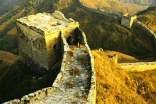
Historical records trace the construction of the origin of the Wall to defensive fortification back to the year 656 B.C. during the reign of King Cheng of the States of Chu. Its construction continued throughout the Warring States period in the fifth Century B.C. when ducal states Yan, Zhao, Wei, and Qin were frequently plundered by the nomadic peoples living north of the Yinshan and Yanshan mountain ranges. Walls, then, were built separately by these ducal states to ward off such harassments. Later in 221 B.C., when Qin conquered the other states and unified China, Emperor Qinshihuang ordered the connection of these individual walls and further extensions to form the basis of the present great wall. As a matter of fact, a separate outer wall was constructed north of the Yinshan range in the Han Dynasty(206 BC--1644 BC.), which went to ruin through years of neglect. In the many intervening centuries, succeeding dynasties rebuilt parts of the Wall. The most extensive reinforcements and renovations were carried out in the Ming Dynasty (1368--1644) when altogether 18 lengthy stretches were reinforced with bricks and rocks. it is mostly the Ming Dynasty Wall that visitors see today. The Great Wall is divided into two sections, the east and west, with Shanxi Province as the dividing line. The west part is a rammed earth construction, about 5.3 meters high on average. In the eastern part, the core of the Wall is rammed earth as well, but the outer shell is reinforced with bricks and rocks. The most imposing and best preserved sections of the Great Wall are at Badaling and Mutianyu, not far from Beijing and both are open to visitors. The Wall of those sections is 7.8 meters high and 6.5 meters wide at its base, narrowing to 5.8 meters on the ramparts, wide enough for five horses to gallop abreast. There are ramparts, embrasures, peep-holes and apertures for archers on the top, besides gutters with gargoyles to drain rain-water off the parapet walk. Two-storied watch-towers are built at approximately 400-meters internals. The top stories of the watch-tower were designed for observing enemy movements, while the first was used for storing grain, fodder, military equipment and gunpowder as well as for quartering garrison soldiers. The highest watch-tower at Badaling standing on a hill-top, is reached only after a steep climb, like "climbing a ladder to heaven". The view from the top is rewarding, hoverer. The Wall follows the contour of mountains that rise one behind the other until they finally fade and merge with distant haze. A signal system formerly existed that served to communicate military information to the dynastic capital. This consisted of beacon towers on the Wall itself and on mountain tops within sight of the Wall. At the approach of enemy troops, smoke signals gave the alarm from the beacon towers in the daytime and bonfire did this at night.
Emergency signals could be relayed to the capital from distant places within a few hour long before the invention of anything like modern communications. There stand 14 major passes (Guan, in Chinese) at places of strategic importance along the Great Wall, the most important being Shanghaiguan and Jiayuguan. Yet the most impressive one is Juyongguan, about 50 kilometers northwest of Beijing. Known as "Tian Xia Di YI Guan" (The First Pass Under Heaven), Shanghaiguan Pass is situated between two sheer cliffs forming a neck connecting north China with the northeast. It had been, therefore, a key junction contested by all strategists and many famous battles were fought here. It was the gate of Shanghaiguan that the Ming general Wu Sangui opened to the Manchu army to suppress the peasant rebellion led by Li Zicheng and so surrendered the whole Ming empire to the Manchus, leading to the foundation of the Qing Dynasty. (1644-1911) Jiayuguan Pass was not so much as the "Strategic pass Under the Heaven" as an important communication center in Chinese history. Cleft between the snow-capped Qilian Mountains and the rolling Mazong Mountains, it was on the ancient Silk Road. Zhang Qian, the first envoy of Emperor Wu Di of the Western Han dynasty (206 B.C-24 A.D), crossed it on his journey to the western regions. Later, silk flowed to the west through this pass too. The gate-tower of Jiayuguan is an attractive building of excellent workmanship. It has an inner city and an outer city, the former square in shape and surrounded by a wall 11.7 meters high and 730 meters in circumference. It has two gates, an eastern one and a western one. On each gate sits a tower facing each other. the four corners of the wall are occupied by four watch towers, one for each. Juyongguan, a gateway to ancient Beijing from Inner Mongolia, was built in a 15-kilometer long ravine flanked by mountains. The cavalrymen of Genghis Khan swept through it in the 13th century. At the center of the pass is a white marble platform named the Cloud terrace, which was called the Crossing-Street Dagoba, since its narrow arch spanned the main street of the pass and on the top of the terrace there used to be three stone dagobas, built in the Yuan Daynasty(1206-1368). At the bottom of the terrace is a half-octagonal arch gateway, interesting for its wealth of detail: it is decorated with splendid images of Buddha and four celestial guardians carved on the walls. The vividness of their expressions is matched by the exquisite workmanship. such grandiose relics works, with several stones pieced together, are rarely seen in ancient Chinese carving. The gate jambs bear a multi-lingual Buddhist sutra, carved some 600 years ago in Sanskrit(3), Tibetan, Mongolian, Uigur(4), Han Chinese and the language of Western Xia. Undoubtedly, they are valuable to the study of Buddhism and ancient languages. As a cultural heritage, the Wall belongs not only to China but to the world. The Venice charter says: "Historical and cultural architecture not only includes the individual architectural works, but also the urban or rural environment that witnessed certain civilizations, significant social developments or historical events." The Great Wall is the largest of such historical and cultural architecture, and that is why it continues to be so attractive to people all over the world. In 1987, the Wall was listed by UNESCO as a world cultural heritage site.
Notes:1. the Taj Mahal in India 印度的泰姬陵2. the Hanging Garden of Babylon 巴比倫的空中花園3. Sanskrit 梵語4. Uigur 維吾爾語
There stand 14 major passes (Guan, in Chinese) at places of strategic importance along the Great Wall, the most important being Shanghaiguan and Jiayuguan. Yet the most impressive one is Juyongguan, about 50 kilometers northwest of Beijing.
Known as "Tian Xia Di YI Guan" (The First Pass Under Heaven), Shanghaiguan Pass is situated between two sheer cliffs forming a neck connecting north China with the northeast. It had been, therefore, a key junction contested by all strategists and many famous battles were fought here. It was the gate of Shanghaiguan that the Ming general Wu Sangui opened to the Manchu army to suppress the peasant rebellion led by Li Zicheng and so surrendered the whole Ming empire to theManchus, leading to the foundation of the Qing Dynasty. (1644-1911)
Jiayuguan Pass was not so much as the "Strategic pass Under the Heaven" as an important communication center in Chinese history. Cleft between the snow-capped Qilian Mountains and the rolling Mazong Mountains, it was on the ancient Silk Road. Zhang Qian, the first envoy of Emperor Wu Di of the Western Han dynasty (206 B.C-24 A.D), crossed it on his journey to the western regions. Later, silk flowed to the west through this pass too. The gate-tower of Jiayuguan is an attractive building of excellent workmanship. It has an inner city and an outer city, the former square in shape and surrounded by a wall 11.7 meters high and 730 meters in circumference. It has two gates, an eastern one and a western one. On each gate sits a tower facing each other. the four corners of the wall are occupied by four watch towers, one for each.
Juyongguan, a gateway to ancient Beijing from Inner Mongolia, was built in a 15-kilometer long ravine flanked by mountains. The cavalrymen of Genghis Khan swept through it in the 13th century. At the center of the pass is a white marble platform named the Cloud terrace, which was called the Crossing-Street Dagoba, since its narrow arch spanned the main street of the pass and on the top of the terrace there used to be three stone dagobas, built in the Yuan Daynasty(1206-1368). At the bottom of the terrace is a half-octagonal arch gateway, interesting for its wealth of detail: it is decorated with splendid images of Buddha and four celestial guardians carved on the walls. The vividness of their expressions is matched by the exquisite workmanship. such grandiose relics works, with several stones pieced together, are rarely seen in ancient Chinese carving. The gate jambs bear a multi-lingual Buddhist sutra, carved some 600 years ago in Sanskrit(3), Tibetan, Mongolian, Uigur(4), Han Chinese and the language of Western Xia. Undoubtedly, they are valuable to the study of Buddhism and ancient languages.
As a cultural heritage, the Wall belongs not only to China but to the world. The Venice charter says: "Historical and cultural architecture not only includes the individual architectural works, but also the urban or rural environment that witnessed certain civilizations, significant social developments or historical events." The Great Wall is the largest of such historical and cultural architecture, and that is why it continues to be so attractive to people all over the world. In 1987, the Wall was listed by UNESCO as a world cultural heritage site.
【北京長城的經典英文導游稿】相關文章:
導游英文自我評價通用07-01
北京,北京作文12-15
陜西-秦始皇陵兵馬俑英文導游辭03-04
《長城》課文09-18
《長城》反思06-07
老北京,老北京作文08-02
(經典)長城課后反思04-12
保護長城的建議03-17
《長城》反思總結06-07
長城課后反思04-12